Executive Summary
Unified Telemetry Ecosystems
Architected and deployed responsive, low-overhead monitoring consoles that bring disparate data streams—hardware sensors, energy generation, power backup, and IoT circuits—into unified, actionable visual hubs.
Sub-Second Performance
Engineered lightweight streaming pipelines using Python and modern dashboard engines, achieving sub-second UI refresh rates with minimal CPU and memory overhead.
Operational Agility & Diagnostics
Empowers rapid technical troubleshooting, automated load-shedding safeguards during grid loss, and optimized energy utilization across residential solar, battery storage, and EV infrastructure.
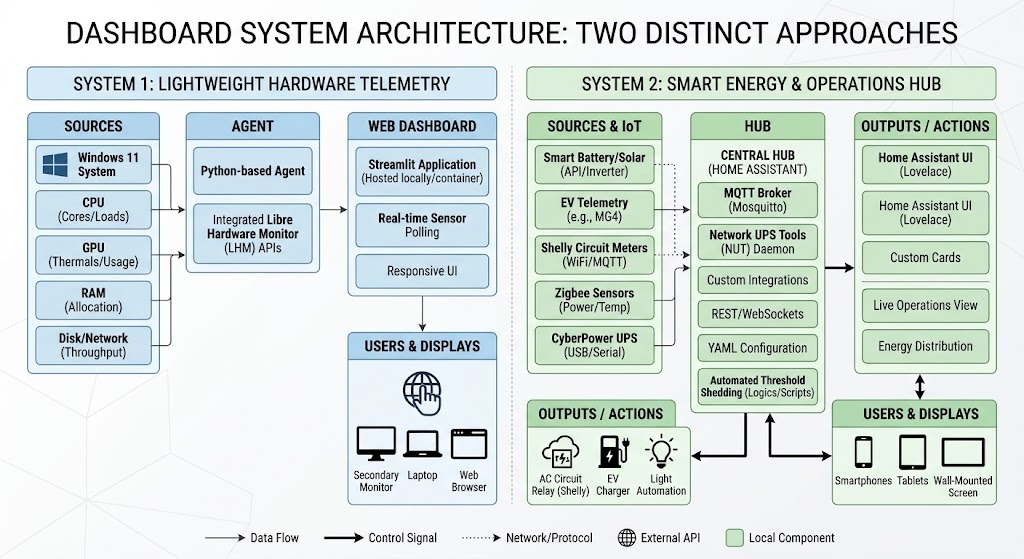
System Architecture: Two Distinct Approaches
Project 1: Live Hardware Telemetry Dashboard
The Operational Challenge
Commercial hardware monitoring suites often impose heavy background resource footprints, lack consolidated multi-metric views, or fail to expose lightweight browser-based interfaces suitable for secondary touchscreens and auxiliary monitoring displays.
Solution Architecture
Built a lightweight, browser-based observability console using Python and Streamlit:
- Direct integration with low-level kernel sensor APIs to sample hardware parameters in real time.
- Multi-threaded sampling engine capturing core CPU loads, GPU thermals and utilization, RAM allocation, and storage throughput.
- High-refresh visual telemetry cards with dynamic warning thresholds for thermal spikes.
Key Outcomes & Performance
Achieved sub-second data streaming latencies with virtually unmeasurable background CPU overhead. The interface adapts seamlessly across primary workstation viewports and dedicated auxiliary monitoring panels.
Engineered with a responsive, dark-mode native layout specifically tailored for glanceable, persistent visibility on secondary vertical and compact touchscreen displays.
Project 2: Smart Energy & Infrastructure Operations Hub
The Operational Challenge
Fragmented, disconnected monitoring interfaces across rooftop solar generation, battery storage, multi-vehicle EV charging, sub-metered appliance circuits, and critical server infrastructure.
Solution Architecture
Engineered a centralized, high-density operational command hub inside Home Assistant:
- Power Resilience & UPS Telemetry: Ingested Uninterruptible Power Supply (UPS) telemetry via dedicated daemons to track grid voltage stability, battery runtime, and active power loads.
- Dynamic EV Charging Analytics: Real-time tracking of charging speeds, session energy delivery, and vehicle State of Charge (SoC).
- Granular Circuit Sub-Metering: Integrated smart circuit relays and wireless sensor arrays to monitor individual high-draw consumer circuits.
Key Outcomes & Operational Impact
Delivered single-pane-of-glass visibility across whole-home power distribution and solar self-consumption. Automated load-shedding sequences activate during utility grid loss to preserve battery runtime for mission-critical services.
Technical Stack Summary
Frontend & Visualization
- Streamlit: Rapid, reactive Python web dashboard framework.
- Home Assistant UI: Custom cards and real-time interactive widgets.
- Modern HTML5 / CSS3: Custom styling and dark-theme design systems.
Backend & Data Ingestion
- Python 3: Asynchronous telemetry ingestion and data processing.
- Low-Level Sensor APIs: Direct kernel and hardware sensor polling.
- NUT Daemon & MQTT: High-throughput message streaming.
Infrastructure & IoT
- Containerized Environments (Docker / Linux): Isolated services for maximum reliability.
- Smart IoT Relays & Mesh Sensors: High-density power monitoring and environmental telemetry.
- Multi-Platform Support: Windows 11, Linux, and mobile client endpoints.